

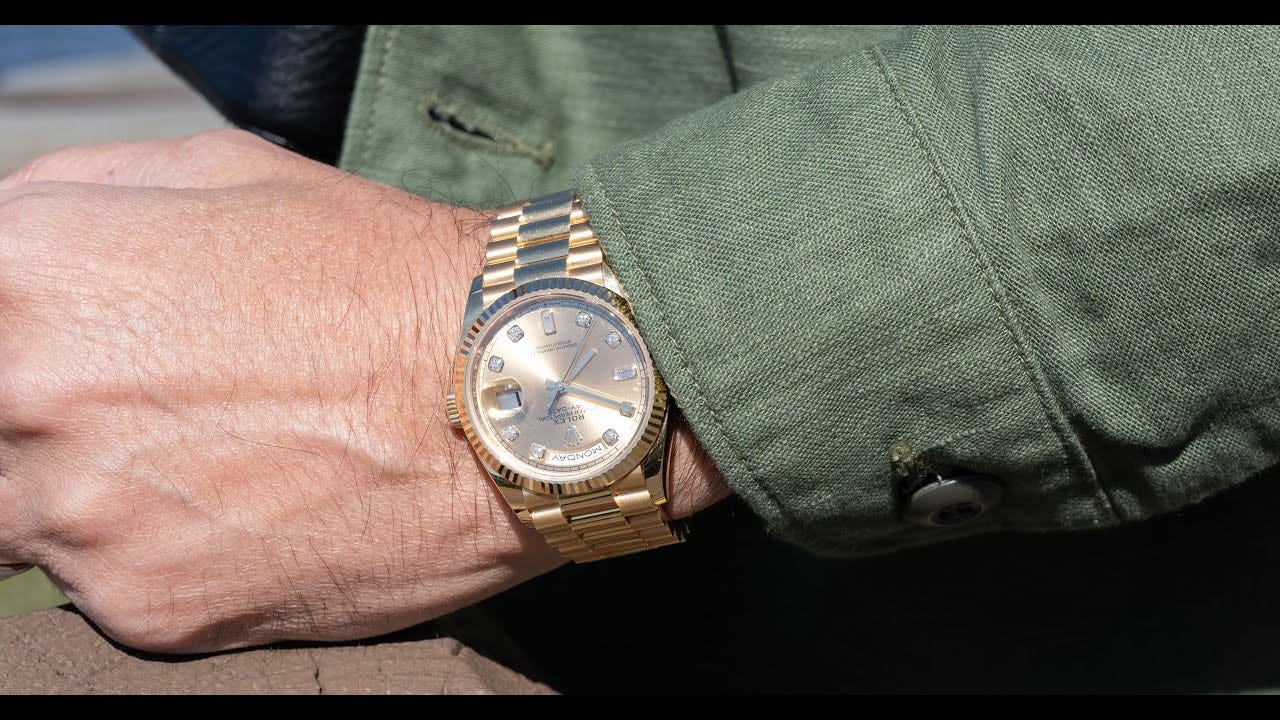
I decided to buy a Rolex. About ten years ago, after a big piece of well-paid work landed on my lap, it seemed like the appropriate thing to do. Things were going well in my career, but apparently, doing work I enjoyed and feeling broadly satisfied with how I spent my time wasn’t quite enough. I thought I needed a big fuck-off watch as proof, just in case anyone was in any doubt about how important I was.
So I went to an antique watch shop in central London and came shamefully close to blowing the lot on a vintage Rolex. I tried it on for size and posed before a mirror. Catching a glimpse of myself with the gigantic, ludicrous timepiece dangling from my wrist, I thought: What a knob. I handed the watch back, banked the cash, and bought myself a cheap plastic Casio instead.
I didn’t really understand why that choice mattered at the time. I just knew that I didn’t want to spend the next part of my life signalling things I didn’t really feel. I wanted to build a life I felt good about, not one I could impress others with. It took years, and the death of my father-in-law, for me to understand what I’d been reaching for in that watch shop.
My father-in-law, Peter Pallai, died last autumn. I gave a eulogy at his funeral. While I wrote it, I was struck by how little I had to say about his achievements (he had many) and how much I had to say about his movement through life. He was a man who never seemed to stop becoming.
He wasn’t a workaholic or driven by wild ambitions. But he was always finding new ways to stay engaged with the world. He started out working on building sites, then became a teacher, then a journalist, before quietly adapting, without any fuss, to a career in jazz music as a promoter, curator, and broadcaster.
He was never bored or bitter, and always curious. The thing I admired most about him was that he kept living life to the end. There never came a point where he was seduced by nostalgia for his ‘golden years.’ He always thought he was living inside his golden years. He applied the gifts he had - intelligence, eloquence, humour and warmth - to a variety of different roles. But it was never reinvention for the sake of applause or status. It was always about adapting, staying interested and looking forward. I wrote more about him here.
The little detail that best defined him, in my mind, was his watch: a cheap plastic Casio. It must have cost him less than twenty quid. From the moment I met him thirty years ago, that Casio was on his wrist. He could have afforded something better, but why would he need such a decoration? He was unfussy and comfortable in his own skin. His watch was functional, not flashy. People who knew him or worked alongside him held him in immense respect. He didn’t need to prove anything about himself with an expensive adornment. I thought about other men who wore flashier watches that did the same job, louder. I wondered why they needed to do that.
There are plenty of risks when you hit fifty. One of the biggest is continuing to outsource your sense of self-worth to flashy symbols. Another is letting your identity harden, refusing to move forward as the world changes, retreating into nostalgia for ‘the good old days.’
I never wanted to become the bloke who moans about how everything used to be better. To avoid that, I focused on movement and adaptability, taking the few talents that had earned me a living and reapplying them to a changing world to stay solvent, interested and fulfilled. Listening to other ageing blokes relive their past glories in the pub was motivation enough.
When working for legacy media firms began to feel brittle and less secure, I explored other ways to do my own thing. Alongside the work I still do for newspapers, broadcasters, and book publishers, I began tentatively building things of my own. Podcasts, especially Top Flight Time Machine (the long-running show I make with Andy Dawson), and later this Substack, gave me something I’d never quite had before: ownership. They offered more choice, greater resilience, and a more satisfying way to make a crust. I’d always written and talked about things other people made (music, entertainment, sport, politics). Gradually, I segued into writing and talking about my own experiences. I wanted to create work that didn’t just comment, but maybe helped. Gradually, I built projects and audiences that had a life of their own, without needing the approval of editors, producers or other gatekeepers.
I didn’t burn anything down. I still write for the papers, publish books with mainstream publishers, and appear on television and radio from time to time. The difference is that now I can choose when and where to work, prioritise my own projects, and work without the constant sense of urgency that once drove everything.
I’m not saying it’s the only way, and I know not everyone has the same options. But it works for me. Success at 50 feels like freedom. Not freedom from work or the luxury of non-stop leisure. More like freedom from the sort of work that doesn’t quite fit with who I am. I have managed to shape my career around my own values, my own interests and the lifestyle I want to lead, not vice versa.
I still get frustrated, occasionally angry and often confused about what to do next. But the Casio on my left wrist serves as a reminder of the path I have chosen: one of fun and function, not status obsession or wistful reminiscing. It’s about taking life seriously, but living it lightly.
It's true. Once you move into your 50s it's about being comfortable with who you are and not what you own. Now I'm about to retire from my career and find new ways to be "just me"
Thanks Sam (TTFN)
Lovely stuff SD